Astrology is often dismissed as entertainment — or attacked as pseudoscience. Yet one of the most influential psychologists of the twentieth century took it seriously. Carl Jung — founder of analytical psychology, architect of concepts like the shadow, archetypes, and individuation — did not treat astrology as a fortune-telling device. He treated it as a symbolic language capable of revealing patterns in the psyche that rational analysis alone might miss.
For women seeking personal insight today, that distinction matters. A birth chart is not a cage. It is a mirror.
Jung and the chart: symbolism, not superstition
Jung’s interest in astrology was consistent and documented. He cast horoscopes for patients during analytic work, corresponded with astrologers, and wrote about meaningful coincidences — synchronicity — events that feel acausally connected yet psychologically significant.
His view was nuanced:
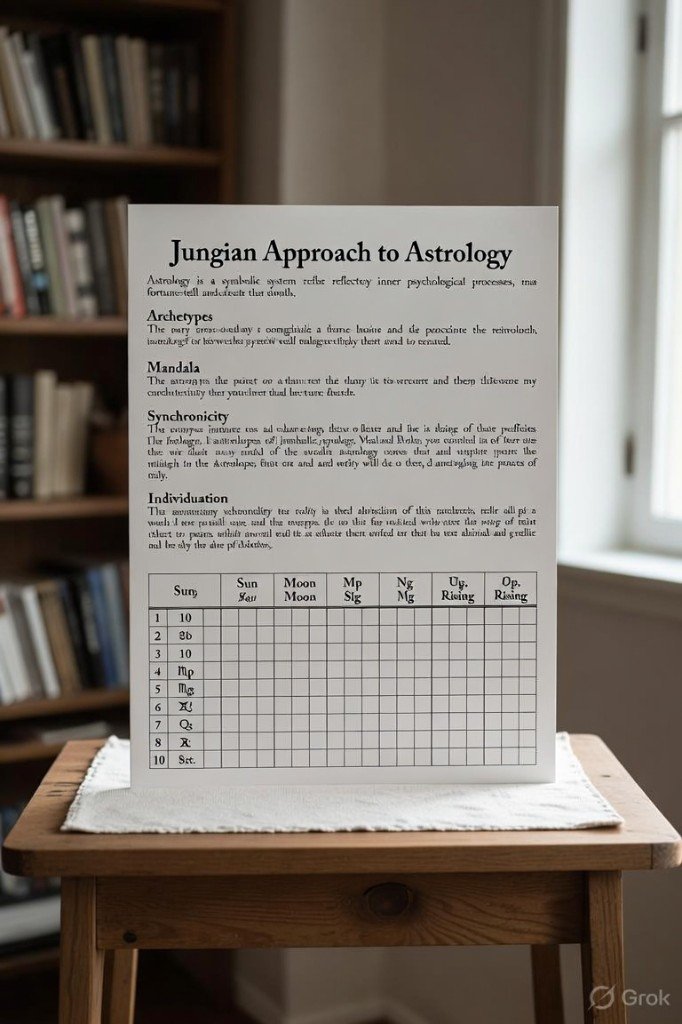
- Archetypes in the sky: Jung saw planetary symbols as expressions of universal human themes — Mars as assertive drive, Venus as relatedness and value, Saturn as structure and limitation, the Moon as the emotional inner world. These map cleanly onto his model of the collective unconscious.
- The chart as a mandala: A natal chart is a circular diagram — a mandala in Jungian terms — that organises psychic material into a whole. Reading it can help a person see contradictions (e.g., a freedom-loving Sagittarius Sun with a security-seeking Cancer Moon) not as flaws but as polarities to integrate.
- Individuation: Jung’s lifelong project was individuation — becoming more fully oneself, including the parts we hide or deny. Astrology, in his framing, offers vocabulary for that journey: where we over-identify, where we compensate, where growth is asking to happen.
Jung did not claim planets cause personality. He suggested they describe symbolic correlations — “in synchronicity with” inner states. Whether you accept that metaphysical frame or simply use the chart as a rich metaphor, the therapeutic value he identified remains: better questions, deeper self-recognition, less shame about complexity.
What a birth chart can reveal about you
Your natal chart is calculated from three pieces of information: birth date, exact birth time, and birth location. From that snapshot of the sky, you receive:
| Placement | Common themes for personal insight |
|---|---|
| Sun | Core identity, vitality, what you are growing toward |
| Moon | Emotional needs, instinctive reactions, comfort |
| Rising (Ascendant) | First impressions, approach to life, physical presence |
| Mercury | Communication style, learning, decision-making |
| Venus | Love language, aesthetics, what you value |
| Mars | Drive, anger, desire, how you pursue goals |
| Saturn | Discipline, fear, mastery, long-term lessons |
Houses add context — which life areas (career, home, partnership, creativity) activate each theme. Aspects — angles between planets — show where parts of you harmonise or tug against each other.
None of this tells you who you must become. It suggests where attention might unlock understanding: Why do I freeze when praised? Why do I attract unavailable partners? Why does rest feel guilty? A chart does not answer those questions for you. It orients you toward them.
Using astrology the Jungian way
If you want insight without surrendering agency, borrow Jung’s posture:
- Read symbolically. “My Saturn in the tenth house” is not a curse on your career. It is an invitation to explore relationship with authority, visibility, and earned competence.
- Watch for projection. We often see chart descriptions in others before we accept them in ourselves. Notice what you resist — it may point to shadow material worth integrating.
- Journal the resonances. Which placements feel true? Which feel wrong? Both responses are data. Your lived experience refines any interpretation.
- Pair with real support. Astrology pairs well with therapy, somatic work, and trusted friendships. Symbolic insight opens doors; relationship and action walk you through them.
This is astrology as personal insight — a companion to introspection, not a substitute for professional mental health care when you need it.
Start with your chart — free
You cannot reflect on a map you do not have. If you have never seen your full natal chart — or only know your sun sign — start by generating one accurately.
AI Birth Charts offers a free birth chart built from your birth data, with clear breakdowns of planets, signs, and houses. It is a practical entry point: no cost barrier, no gatekeeping jargon, and a chart you can bring into journaling, therapy conversations, or deeper study.
Once you have your chart in hand, sit with one placement per week. Ask Jung’s favourite kind of question: What is this part of me trying to express — and what have I been afraid to hear?
That is where astrology stops being a trend and starts being a tool — the same kind of tool Carl Jung recognised when he looked at the circle of the horoscope and saw not fate, but the Self, waiting to be known.